The Blue Carriage and the Woman in White: A Portrait of Ephemeral Grace
By Madan Shrestha
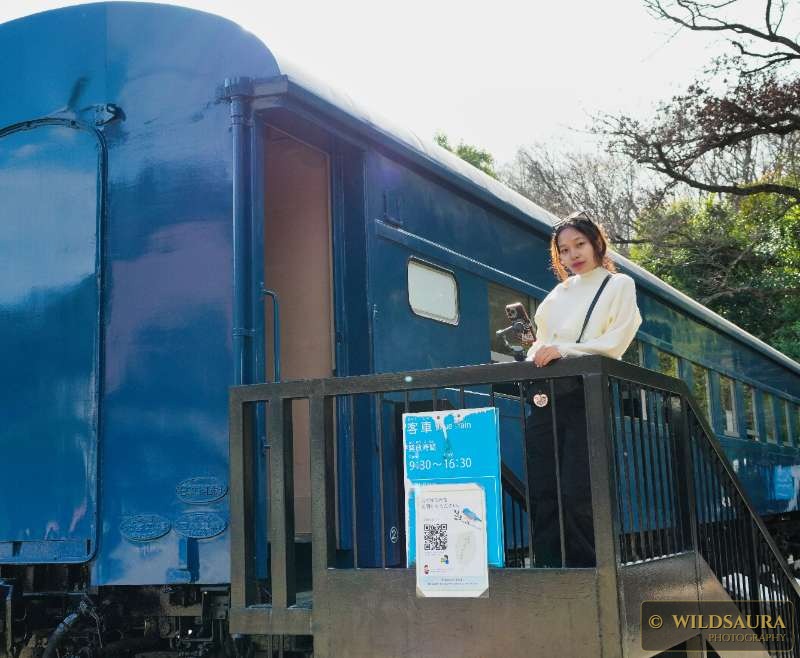
The journey was a pilgrimage into the past. I had come to a small, sun-dappled railway park in the Japanese countryside, a sanctuary for retired train cars. The air was still and warm, thick with the scent of creosote and damp earth from a recent shower. My destination was a particular vintage blue carriage, its paint faded to a soft, milky azure, resting on a short stretch of track like a sleeping giant. I arrived in the late afternoon, chasing the golden hour, knowing its slanted light would transform the scene from a static exhibit into a living memory.
For nearly an hour, I waited, my Nikon Z9 resting on a monopod. I framed the empty carriage, the 85mm f/1.8 lens compressing the background of lush maples into a soft, green tapestry. Patience, a skill honed in the wild, is just as vital in this pursuit. I wasn't waiting for an animal to emerge from the undergrowth, but for the right human element—a soul who would not just pass by, but *interact* with the scene, giving the inanimate metal a story. I pre-focused on the carriage door, my settings dialed to f/2.8, ISO 200, and a shutter speed fast enough to freeze a candid moment, yet slow enough to let the warm light glow.
Then she appeared. A woman in a simple, elegant white dress, her movements unhurried and deliberate. She didn't just glance at the carriage; she approached it with a quiet reverence. She paused, her hand hovering near the cool, riveted metal, her gaze distant, as if listening to echoes of steam whistles and clattering wheels. This was the behavior I sought: not a posed smile for a camera, but an authentic, unguarded moment of communion. She leaned gently against the blue steel, her white dress a stark, beautiful contrast against the aged paint, her posture one of nostalgic reflection. In that instant, she wasn't a tourist; she was a spirit from the train's own history, a temporary inhabitant of its timeless story.
Technically, the scene was a gift. The 85mm lens isolated her perfectly, rendering the background trees as a creamy bokeh that made the blue carriage pop. The composition used the lines of the train and tracks to lead the eye directly to her, the sole point of human warmth in a scene of cold machinery. I fired a rapid, silent burst, capturing the subtle tilt of her head, the way the low sun gilded her profile and set the blue paint ablaze with highlights. It was a portrait of a person, but also a portrait of a memory.
Emotionally, this encounter resonated deeply. As a wildlife photographer, I am attuned to capturing the essence of a creature in its habitat. Here, the 'creature' was a moment of human grace, and the 'habitat' was a preserved fragment of industrial history. It reminded me that beauty and story are not confined to remote jungles; they exist wherever there is a poignant intersection of humanity, history, and light. It was a lesson in seeing the wild aura in the civilized world.
This leads me to a conservation message of a different kind. Preserving these mechanical relics and the quiet, green spaces that house them is as crucial as preserving natural habitats. They are ecosystems of memory, teaching us about our journey, our engineering spirit, and the romance of travel. Protecting such places allows for these fleeting, powerful connections between generations. They are repositories of stories, waiting, like this blue carriage, for someone to lean against them and listen. To learn more about the cultural significance of preserving such railway heritage, you can explore this resource: https://en.wikipedia.org/wiki/Woman_Posing_by_a_Vintage_Blue_Train_Car.