The Watchful King: A Solitary Crow in the Whispering Woods
By Madan Shrestha
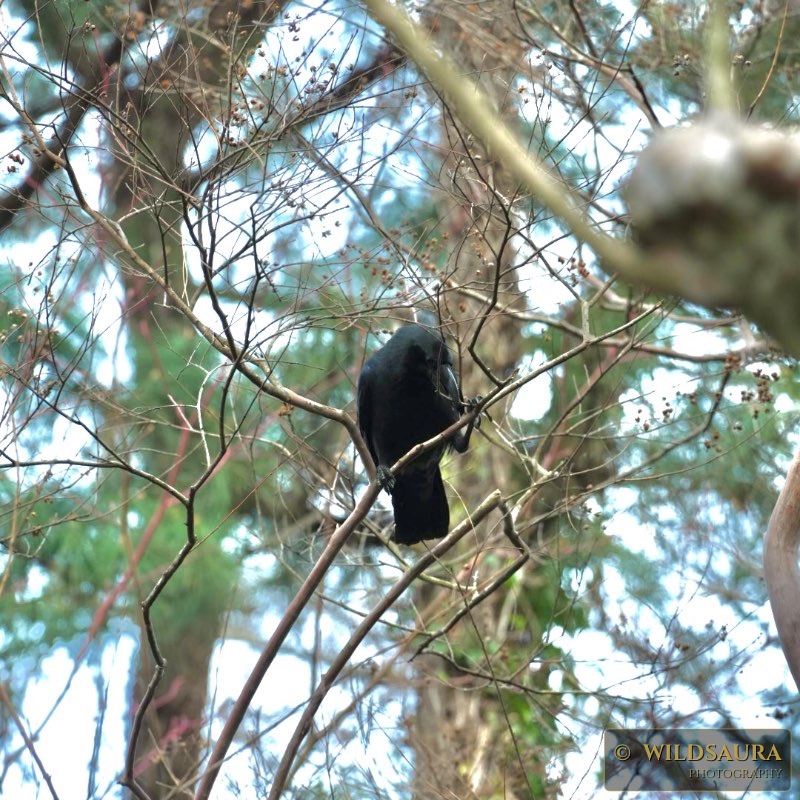
The afternoon sun was a low, gilded coin filtering through the dense canopy of the wooded area, casting long, dancing shadows and painting the understory in hues of amber and deep green. I had come without a specific quarry in mind, seeking instead the quiet pulse of the forest, the small dramas that unfold away from the spotlight. The air was cool and carried the scent of damp earth and decaying leaves, a perfect canvas for the subtle. I settled against the mossy trunk of an old oak, my senses tuning to the rustle of a squirrel, the distant tap of a woodpecker, and then—the profound, observant silence that seemed to emanate from a single, dark figure perched on a skeletal branch ahead.
For nearly an hour, I waited, my camera a silent extension of my own held breath. This was not the frantic chase of action photography but a slow, deliberate communion. The crow, a member of the genus Corvus, was motionless, a carved silhouette against the mottled light. I knew from my readings that these birds are among the most intelligent in the avian world, and its stillness felt not like vacancy, but like intense calculation. I anticipated a flight, a call, any break in its regal poise that would reveal its essence. My patience was a form of respect, an offering to the wild aura of this common, yet deeply mysterious, king.
Then, it moved. Not with a startled flap, but with a deliberate, powerful turn of its head, fixing one gleaming, obsidian eye directly on my lens. The light caught the iridescent sheen of its black feathers, revealing hidden purples and blues—a suit of polished armor. It let out a low, resonant *caw* that seemed to vibrate in the still air, a sound that spoke of territory and awareness. I was struck by its singular presence; though a group of its kind is poetically known as a 'murder,' this individual commanded the space with a solitary, formidable dignity. It preened a primary feather with fastidious care, then hopped along the branch with a confident, almost thoughtful gait, fully aware of my presence yet utterly unbothered.
Technically, the challenge was to capture the detail in the shadows and the intelligent glint in its eye. I used my trusted 400mm prime lens, allowing me to keep a respectful distance and compress the background into a soft, green bokeh that made the crow pop. My settings were a balancing act: aperture at f/5.6 to isolate the subject, a shutter speed of 1/1000th to freeze any subtle movement, and ISO pushed to 800 to compensate for the forest's dim light. I framed the shot tightly, placing the crow off-center according to the rule of thirds, its gaze leading into the negative space of the misty woods, suggesting its vast domain.
This encounter was a humbling reminder that majesty does not always roar; sometimes, it watches in silence from a bare branch. As a photographer, I am often chasing the rare and the spectacular, but this crow reminded me to see the profound intelligence and beauty in the everyday. It was a masterclass in stillness, a lesson that the most compelling stories are often told not through action, but through presence. I left feeling not like I had taken a photo, but like I had been granted an audience.
Protecting species like the crow is fundamentally about protecting the integrity of ecosystems they help maintain. As omnivorous scavengers and predators, they are crucial cleaners and controllers of insect populations. Their intelligence is a testament to the complex evolutionary journeys that thrive in healthy habitats. When we preserve the wooded areas, the tangled hedgerows, and the open skies, we are not just saving 'common' birds; we are safeguarding the intricate web of which they are a vital, clever thread. To learn more about the fascinating genus Corvus, you can visit the Wikipedia page here: https://en.wikipedia.org/wiki/Crow.